
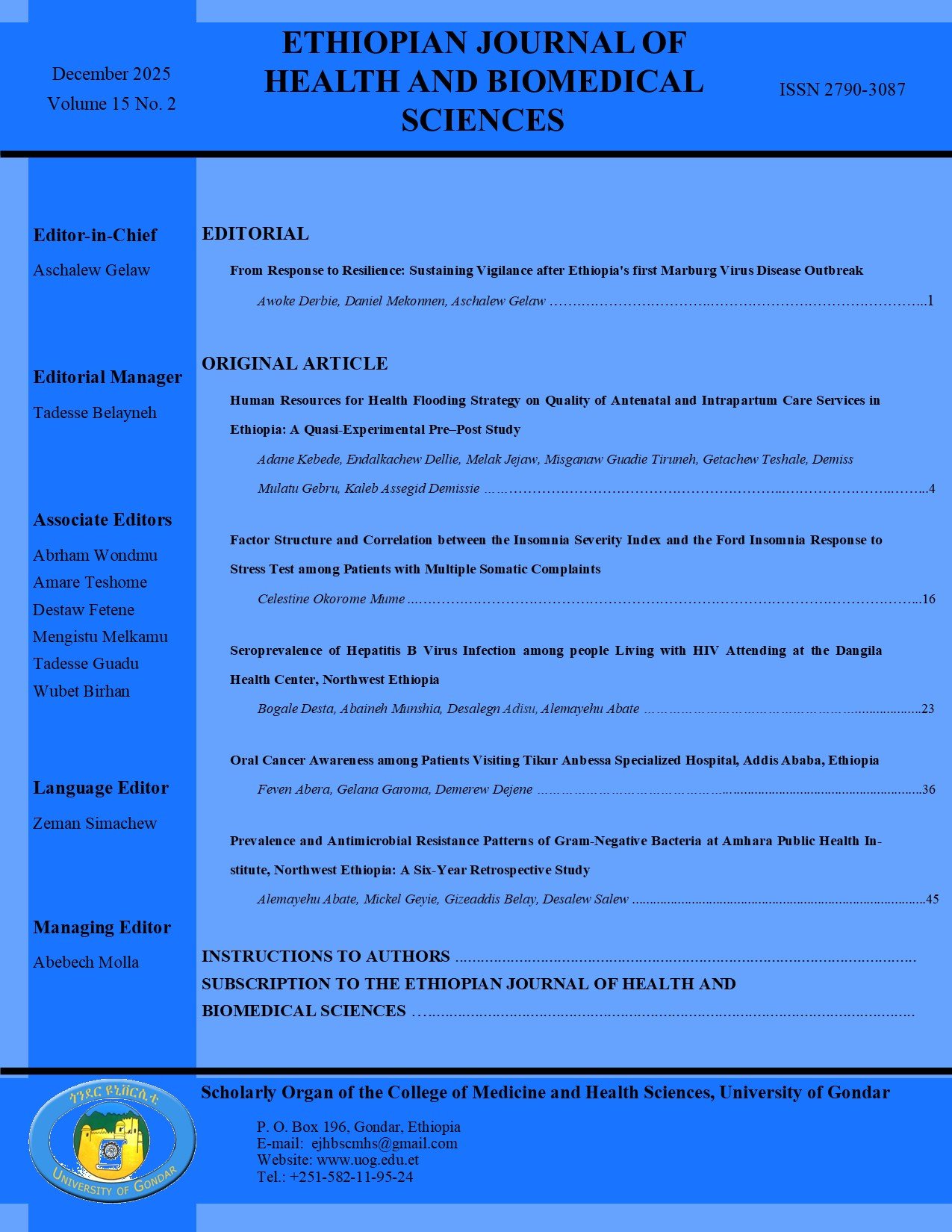
Factor Structure Analysis and Total Score Correlation of the Insomnia Severity Index and the Ford Insomnia Response to Stress Test in Patients with Multiple Somatic Complaints
DOI:
https://doi.org/10.20372/ejhbs.1027Keywords:
Factor structure, Correlation, Insomnia severity index, Ford insomnia response to stress test, Sleep reactivity, Multiple somatic complaintsAbstract
Background: Insomnia and sleep reactivity are common among patients presenting with multiple somatic complaints. The Insomnia Severity Index (ISI) and the Ford Insomnia Response to Stress Test (FIRST) are widely used instruments to assess insomnia severity and sleep reactivity, respectively. However, their factor structures and interrelationships have not been examined in this population.
Objective: To determine the factor structure and internal consistency of the ISI and FIRST and assess the correlation between their total scores among patients with multiple somatic complaints.
Materials and Methods: A cross-sectional study was conducted among 111 adult psychiatric outpatients presenting with multiple somatic complaints at Obafemi Awolowo University Teaching Hospitals Complex, Nigeria. Sociodemographic data were collected, and participants completed the ISI and FIRST questionnaires. Exploratory Factor analysis using maximum likelihood extraction with varimax rotation was applied to the ISI, while principal component analysis was used for the FIRST. Internal consistency was assessed using Cronbach’s alpha. Correlation and simple linear regression analyses were performed to evaluate associations between the instruments.
Results: Data from 110 participants were analyzed (mean age 39.4 ± 8.7 years; 58.2% female). The ISI demonstrated a two-factor structure explaining 47.22% of the variance, with an overall Cronbach’s alpha of 0.67. The FIRST demonstrated a single-factor structure explaining 56.40% of the variance, with excellent reliability (Cronbach’s alpha = 0.90). A significant positive correlation was observed between ISI and FIRST scores (r = 0.40, p < 0.01). Linear regression analysis showed that sleep reactivity accounted for 15% of the variance in insomnia severity (Adjusted R² = 0.150, p < 0.01).
Conclusion: The ISI and FIRST demonstrated acceptable construct validity and reliability in this population. Sleep reactivity was significantly associated with insomnia severity, supporting the clinical utility of FIRST in identifying individuals at risk for insomnia.
Downloads
Downloads
Published
Data Availability Statement
The data supporting the findings of this study are available within the article and its supplementary materials. Any additional data required are available from the corresponding author upon reasonable request.
Issue
Section
License
Copyright (c) 2026 Celestine Mume

This work is licensed under a Creative Commons Attribution-NonCommercial 4.0 International License.
Copyright & Licensing © Year The Author(s). This is an open-access article is distributed under the terms of the Creative Commons Attribution 4.0 International License (CC BY 4.0), which permits unrestricted use, sharing (copying and redistributing the material in any medium or format), and adaptation (remixing, transforming, and building upon the material for any purpose), provided the original author(s) and the source are properly cited/credited, and provide a link to the license. To view a copy of this license, visit http://creativecommons.org/licenses/by/4.0/
How to Cite